Saturday, January 4, 2020

Connie's Post. Christmas Travelers_ COMUNA 13 part one

Location of Medellin
Debbie, DeVon, Brian, and Steven
Connie’s Post. Christmas Travelers: December 2019. Clair and I travelled with 3 others to the Colombian Department [state] of Antioquia whose capital is Medellin. This region of Colombia lives in perpetual summer, rain almost daily, flowers of all types blooming year round; temperatures were in the mid-70’s. Medellin is the second largest city in Colombia; its population is about 2.5 million people. Medellin has 16 comunas or districts. We visited the district of COMUNA 13 on 31 December. We arrived by Metro at the San Javier Station and recruited Steven, an English teacher during the school year, to help us find our way. He led 3 young French women and us on our two hour tour. Steven was knowledgeable, articulate, and very helpful.
Outside the San Javier Station
Food is always available
Others looking to be a tour guide

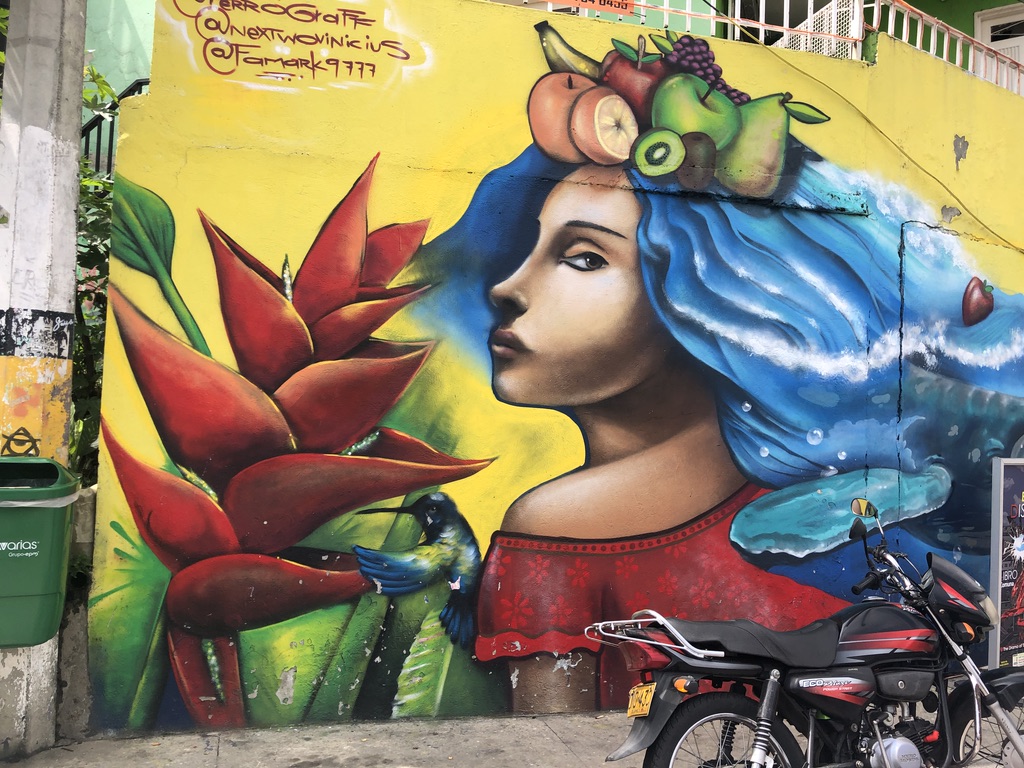
 Also called San Javier Comuna, this district has about 160,000 people and is famous for its history of la resistencia and its wall murals and graffiti. 
Here, people make a distinction between murals [painted on with a brush; less expensive] and graffiti [applied with spray cans of paint, even as many as 50 cans; expensive]. 

We are all immigrants
Historically, in the 1950’s and 1960’s, migrants/immigrants coming to the city from rural areas sought land but ‘we were told by the government that there was nothing for us’ so they themselves tamed the steep, densely forested land on the western edge of Medellin and created living space. During the violent political period of 1980’s and early ‘90’s, Comuna 13 refused to be co-opted by the guerrillas, nor by the para-military groups, nor by the drug dealers, nor by the government. Still today, they are proud of their resistencia. In graffiti, the image of the hummingbird [colibrí] stands for independence/ resistance and also for ‘your wish’ ‘your hope’. 


   Eventually the government recognized the ownership of the land among people who had built brick and concrete homes and lived in them for 30 years.
Land rights and ownership were granted and basic community and sanitary services began to be provided. 

Graffiti images are tremendously symbolic.  Many show a violent or sad past on the left and a hope and looking forward to the future on the right.
Colibrí
the lotus flower symbolizes peace

the phoenix
The images speak of hope and expectation of rebirth [re-nacer; the phoenix], searching for peace [lotus flower].


Someone cannot just come in and start to put up graffiti. The plan for your wall art has to be submitted to a committee, approved, and your art has the use of the wall for about 6 months.


Some graffiti are messages of protest [Amazon burning].


C 13 Resistencia
Amazon Burning


[continued in part two]


Sunday, November 10, 2019

Hixsons at Machu Picchu

Connie and I were able to visit Machu Picchu about two weeks ago.  The Machu Picchu Sanctuary is somewhat of a logistical challenge to visit.  We were with a large group of fellow missionaries and volunteers and made a long day trip from Cusco.  For a photographer, this is not an ideal plan.  We left our hotel in Cusco at 5:20 AM and drove in minivans for 1.5 hours to the Incan town of Ollantaytambo.  It used to be possible to take a train from Cusco to Ollantaytambo, but the train no longer reaches Cusco.  Once in Ollantaytambo, we transferred to a Peru Rail train for the 2-hour ride to Aguas Calientes, the town at the base of the mountain where Machu Picchu is located,  There, we took a 25-minute bus ride up the mountain to the sanctuary.  After spending about 5 hours at Machu Picchu, we retraced our route to Cusco, arriving back to the hotel 15 hours after our departure.

If we are able to return to Machu Picchu, we would make a two-day trip.  The sanctuary opens at the early hour of 6 AM, so I would stay overnight at Aguas Calientes and travel up the mountain early the next day before the day trippers arrive and while the light is softer.  

The wet season has now begun in the mountainous regions of Peru.  Machu Picchu is best visited from early May to the end of October.  During the wet season, sometimes the ruins cannot be viewed from the overlooks due to fog and clouds.  

On the day we visited, the weather was a little unusual in that we had bright sunny conditions all day.  Some clouds were present over the surrounding mountains, but because we arrived at midday, the light at Machu Picchu was bright and harsh.  This made photography a challenge.  Nevertheless, given the light conditions, I am pleased with some photos I was able to make. 

 Here are a few photos I made during our day trip to Machu Picchu.  


Some llamas live at Machu Picchu.


This is the classic view of the ruins at Machu Picchu from near the entrance to the sanctuary.


View of the city of Machu Picchu from a walled and terraced courtyard.


Ruins of a house with terraces beyond.


Before our visit, I did not appreciate the extensive terraces that the Incans constructed into the steep mountainsides for agriculture. 


Tuesday, October 8, 2019

Photos from Lomas de Lachay, Peru

Connie and I continue to remain busy in Peru assisting in caring for the health and safety of about 6,000 missionaries scattered throughout Bolivia, Colombia, Ecuador, Peru and Venezuela.  Because of the political situation in Venezuela, we do not travel there, but we communicate by phone or email with those who have health questions and problems.  When we first arrived in the area, I spent a lot of time determining how to obtain prescription drugs and vaccinations to people in Venezuela.  We have succeeded in accomplishing that goal.  We spend most of our days fielding calls and emails about individuals with a plethora of medical problems.  The most common ailments are probably skin problems and orthopedic injuries.  We have traveled to Colombia and Ecuador to teach about prevention of such problems as dysentery, insect-borne illnesses, rabies and a number of other issues.  We have had a number of cases of tuberculosis and dengue to deal with.

Every few weeks we have a free Saturday.  Sometimes, we visit a park or market in Lima.  A few weeks ago, we went with some friends to a national nature reserve located about 2 hours north of Lima called Lomas de Lachay.  This is a unique place that is very green during the cooler winter months, unlike most of the coast of Peru.  In South America, weather moves from east to west - the opposite of weather patterns in North America.  Because of the Andes Mountains that lie to the east of the coast, we live in a rain shadow.  Lomas de Lachay is unusual because the area is very green.  It is not green from rainfall, but from moisture derived from dense fog that layers the area almost every day during the winter season.  The reserve is located a few miles inland from the ocean and as you drive inland and uphill, the area becomes more foggy.

On the day we visited Lomas, the fog was very dense.  We hiked one of the several trails that ascend the foothills of the Andes.  There were many wildflowers in full bloom and several species of birds.  This is the only place along the coast of Peru that does not appear to be a barren desert.  

Below are a few of the photos that I made during our hike in the fog.  At the end of this month, we plan to go to Machu Picchu, so I hope to obtain good photos there. 


 Trees and bushes along a trail in Lomas de Lachay in the foothills of the Andes.  The plants receive their moisture from the dense fog.


 Members of our group of visitors to Lomas de Lachay hiking the trail in fog.


In the afternoon, some of the fog begins to lift.  This is a hillside covered with green grasses and yellow flowers - a scene never seen in Lima.


A section of the trail that we hiked at Lomas de Lachay.  The visibility was usually about 50 yards.


Tuesday, September 10, 2019

Hixsons in Ecuador

Connie and I recently traveled to Quito Ecuador to do some teaching and medical consulting.  While in Ecuador, we traveled a few miles north of Quito to visit the Equator and an associated museum.  We also took an overnight trip to Otavalo, a town located about two hours north of Quito.  I had been told about this town by one of our colleagues.  The public bus to Otavalo was very modern and comfortable and cost about 2.50 USD.  Ecuador uses the U.S. dollar as its currency.
The attraction of Otavalo is that is has the largest outdoor handicraft market in South America.  We spent several hours wandering around the colorful market.  I took photographs and Connie purchased a sweater, two decorative pillow covers, a tablecloth and some items for the grandchildren.
After visiting the market, I wandered around the town and photographed some street scenes.
We are now back in Lima and working long hours.  The doctors in South America practice very differently from how we practice in the U.S.  Many of them do not seem to be skilled at obtaining detailed medical histories and performing careful exams and they rely too much on imaging studies.  We spend a lot of time trying to avoid unnecessary testing.
Now that we are in September, it has begun to warm up just a little.  The skies are still gray almost every day and mist is common.  One of the pleasures of traveling to Ecuador was seeing the bright blue sky.
In late October, we will be traveling to Cusco to attend a Church conference and do some more medical teaching.  We are planning to go to Machu Picchu.

Here are some photos I made in Otavalo Ecuador.

 Colorful yarn in the Otavalo market

 Hand embroidered decorative pillow covers in the Otavalo market

 A hand-weaved wall hanging found in the Otavalo market

Connie purchased a sweater from this woman in the Otavalo market.  Almost all of the women in the market wore these traditional gold necklaces.

While exploring the streets of Otavalo, I came across a secluded and colorful courtyard.  The cinder block walls were brightly painted and the benches were also painted to blend into the wall - very interesting.

This is another painted wall with a hanging flower pot that appears to be part of the painting.

Thursday, August 1, 2019

Hello from Lima Peru

We continue to be busy in Peru and the surrounding countries.  We are asked to assist with a plethora of problems ranging from the mundane URIs, acne and various aches and sprains to more serious problems such as fractures, mental health problems, dysentery, epilepsy, high-altitude illnesses, dengue fever, scorpion stings to the face, dog bites, etc.  Clair has even had a few cardiology cases.  Careful records of all interactions are maintained to track trends and needed teaching.  We spend a lot of time teaching about how to prevent injuries and illness.

Clair recently began visiting a center for adolescent boys who have been abandoned by their families or whose families are unable to care for them.  We are developing plans to provide much needed periodic health care for boys in that facility.  

We plan our weeks, but often emergencies interrupt those plans.  Everyday is an unknown entity.  Here in Lima, we have met many wonderful neighbors and friends.  

Currently, we are in the coldest part of the year in Peru.  The weather in Lima during the winter is dreary.  Every day is overcast and on most days there is considerable mist making the sidewalks and streets wet and slippery.  Because of the high humidity, constantly overcast skies and the mist, it often feels cold.  It very rarely rains in Lima; we have been here for five months and there has been no measurable rain.  

Next week, we will travel to Bogota, Colombia to teach a number of people about how to prevent illnesses from unclean water and food and from insect- and arthropod-borne illnesses.

We continue to study and slowly learn Spanish, but some days are too busy to study.  If there is not time to study, Clair will spend a few minutes with the app Duolingo, which is quite helpful.  Connie spends lunchtime talking in Spanish with Peruvian women friends in the office.  Sometimes on Saturdays, we are free enough to go to a museum, do our weekly grocery shopping or even go out to dinner.  Lima does have many excellent and inexpensive restaurants.  

Peru has a number of beautiful handicrafts.  It probably best known for its colorful fabrics.

Here are a few photos of handicraft items that we have purchased in Peru.


In the area around Huancayo Peru, artisans make "carved gourds."  This has been an art form in that area of Peru for thousands of years.  Some are carved with abstract designs; this one has a bird motif.


This is a weaving that we purchased in a village near Cusco.  It is a common theme called Pacha Mama.


This is an oil painting that we purchased for our apartment.  It portrays an Incan village in the Cordillera Blanca, the range of mountains to the northwest of Lima that rise to more than 22,000 feet elevation.


This is a wood carving from Woodflair, a Lima-based artisan shop that was founded by a man from England. 


Sunday, June 23, 2019

Photos from Kuélap Peru

Last week, my wife, four friends and I were able to make a quick trip to northern Peru to visit some interesting sites.   We flew from Lima to Jaen and then drove for about three hours to the city of Chachapoyas where we lodged for three nights.  
On our first full day in the region, we traveled to Kuélap, a site I had not heard of before coming to Peru.  Kuélap is a walled settlement and citadel built by the Chachapoyas (or Cloud Warriors) culture that preceded the Incas.  This stone city and fortress is perched at the top of a mountain at 9,800 feet elevation overlooking the Uctubamba Valley.  The city was built in the 6th century A.D. and was home to at least 5,000 people.  Ultimately, the Chachapoyas were defeated by the Incas shortly before the Spanish arrived in the 16th century.  
Until recently, Kuélap was very difficult to access due to its remote mountaintop location.  In 2017, a French company constructed a gondola which now carries visitors across a deep canyon and then up the steep mountainside to near the top of the mountain.  Visitors then walk for about 25 minutes up to the ruins.  
Almost all of the structures in Kuélap are circular in shape.  The people lived in circular stone houses with wood and thatched roofs.  The roofs are gone, but the stone foundations of more than 500 such structures remain today.
On the day that we visited, photography was a challenge due to harsh mid-day light.  Toward the end of our four-hour visit, increasing clouds provided less contrasty light and I was able to make some photos that were acceptable.  Here are a few photos that I made last week in Kuélap Peru.


This image shows part of a stone wall that surrounds Kuélap.  The foundation of a typical round house sits above the wall.


Stone foundations of houses at Kuélap, Peru.


Several llamas live at Kuélap and I was able to photograph them among the ruins.  This perfectly positioned llama was grazing above a group of circular stone structures.  Note the valley far below the mountaintop location of Kuélap.


A typical circular stone house at Kuélap.  What a view!


Llamas at the ruins of Kuélap.

Sunday, May 5, 2019

Photos of Cusco, Peru area

Connie and I were able to make a three-day visit to Cusco, Peru.  We chose not to go to Machu Picchu since we will have that opportunity later and we wanted to explore the city of Cusco and some nearby villages and Incan archaeological sites.  The air in Cusco is much cleaner than in Lima and it was significantly cooler and refreshing.  Cusco sits at an altitude of 11,300 feet and walking up the steep streets in the San Blas neighborhood where we stayed induced some shortness of breath.  Except when walking uphill, the altitude did not bother me, but it caused Connie headache and fatigue for the first day.

I took many photos and will post others later, but here are a few images that I made of Quechua people in native costumes.  At this time of year, there are many native festivals and the people dress up for the occasions - good for photography.


This Quechua man allowed me to photograph him while he played his flute at the archaeologic site of Q'enqo.


Two Quechua women in native dress with a baby llama in an alley of Cusco.


Quechua woman at a local festival in Chinchero, Peru


Quechua woman spinning wool in her weaving shop in Chinchero, Peru